
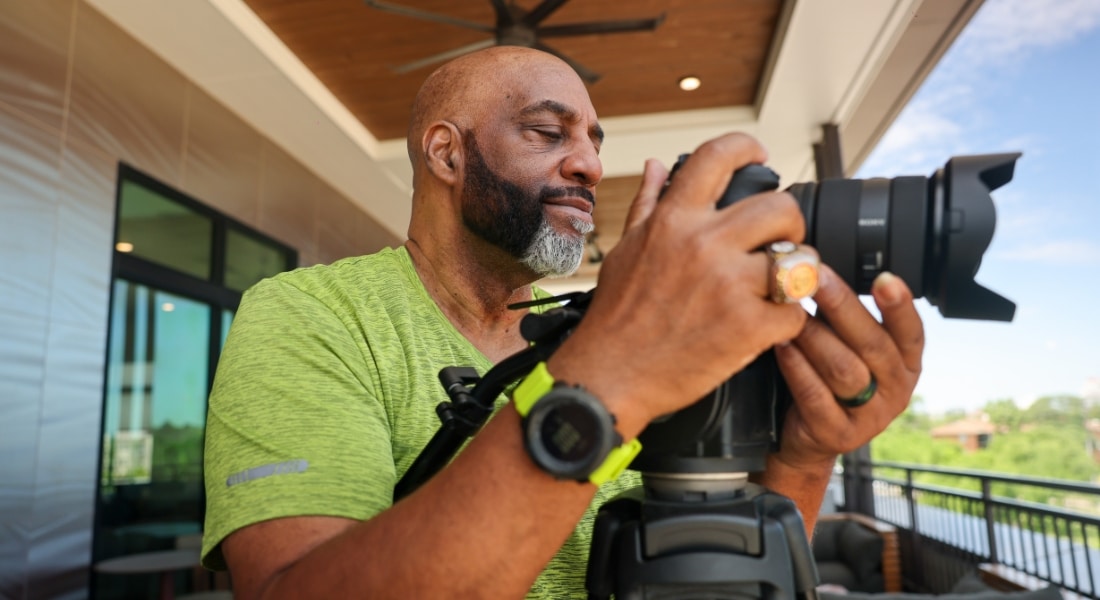
Photojournalist Robert Flagg spent his career capturing breaking news for TV stations across North Texas, but all those years hauling heavy cameras nearly broke him.
“I call it the comeback,” Robert says. “I was knocked down, but now I’m coming back.”
More than a year after spinal fusion surgery at Methodist Southwest Medical Center, Robert has fought back from near-paralysis to become one of those feel-good stories he once covered for the TV news — but this time on the other side of the lens.
“I’ve covered a lot of major events,” he says. “But for me to be on the other side of it … it has really touched me beyond words. Methodist Southwest saved my life.”
UNABLE TO WALK
Anyone who’s watched broadcast news in Dallas-Fort Worth over the past 30 years has seen Robert’s work.
As a longtime TV cameraman, often “running and gunning” on the overnight shift, Robert was used to physically demanding work: moving heavy gear quickly in unpredictable situations, from seven-alarm fires and dangerous weather to smash-and-grab robberies and thousands of homicides.
“We had three Ds,” he says of the newsroom’s stock in trade, “death, destruction, and dumb stuff.”
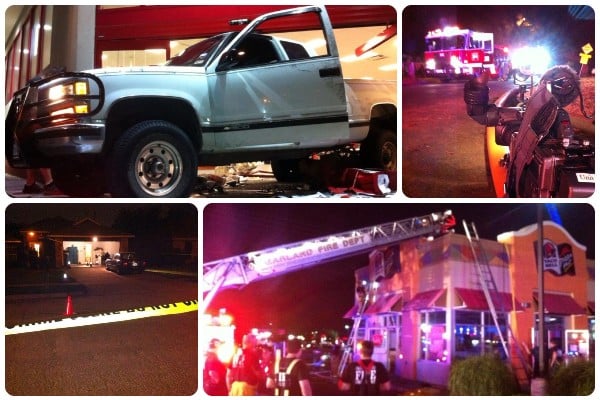
Over time, that wear and tear took a toll on Robert’s back, and several on-the-job car crashes only made it worse. In early 2024, the pain became impossible to ignore.
“It’s the worst pain possible,” he says. “I had to crawl from my car to the house.”
Robert’s condition continued to worsen until one day, after returning from a trip with his mother, he nearly lost consciousness from the pain.
“I told her, ‘Call 911. I’m going to pass out,’” he says.
Robert was taken by ambulance to Methodist Southwest, where doctors began searching for answers.
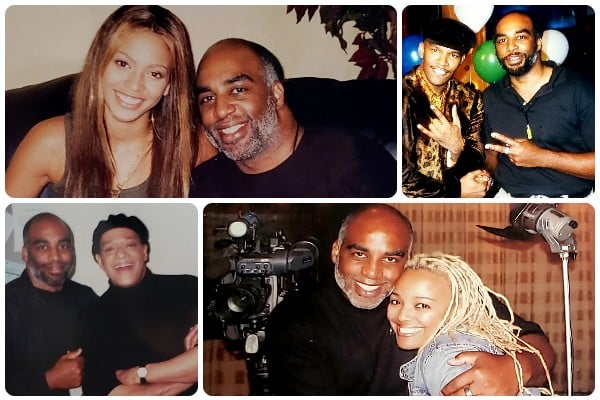
Robert crossed paths with Beyoncé and Jamie Foxx, among other celebrities, while working in TV news.
SPINAL FUSION
At the hospital, imaging revealed severe damage to Robert’s spine. The situation was critical, says Randall Graham, MD, neurosurgeon on the medical staff at Methodist Southwest.
“He was completely unable to walk or really even to stand up,” Dr. Graham says. “He was essentially bedbound.”
Scans of Robert’s back showed significant compression of the spinal cord across multiple levels. Without surgery, he risked permanent paralysis.
“I really don’t think he had much room or much time left before needing some kind of intervention,” Dr. Graham says.
From sports injuries to chronic orthopedic conditions, our team offers complete care to relieve pain and restore an active lifestyle. Visit MethodistHealthSystem.org
Dr. Graham recommended immediate spinal fusion — a complex procedure to stabilize the spine and relieve pressure on the spinal cord.
The surgery involved placing rods and screws to stabilize the spine, then removing bone and tissue that was compressing the spinal cord.
“We had to remove all of that overgrown bone and ligament that was absolutely smashing his spinal cord,” Dr. Graham says. “It ended up being much more delicate than we thought.”
Despite the complexity of the seven-hour surgery, Robert went into the surgery placing his full faith in Dr. Graham and the rest of his care team.
“I had total confidence in them,” Robert says. “The way they were making me feel. It’s like, ‘Hey, we got you. We’re going to take care of you.’ They made me feel like I was part of the family.”
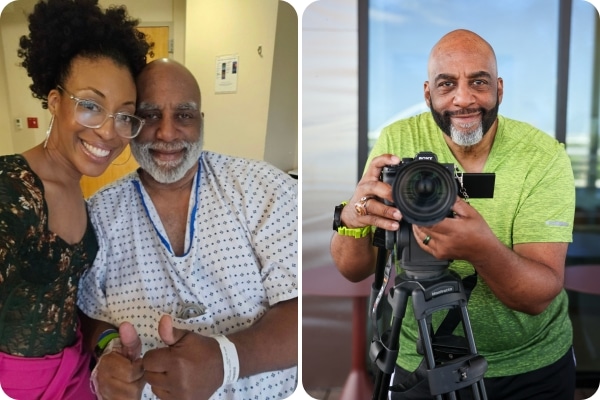
Robert had the support of his daughter, Emily, to help him get him back behind the camera.
NEVER GIVING UP
Recovery was not immediate for Robert, and rehabilitation became a major commitment.
“It is a job,” he says. “It’s one day at a time.”
Dr. Graham said Robert’s determination played an important role in his successful recovery.
“This is a testament to his will and his strength,” Dr. Graham says. “He didn’t give up.”
For Dr. Graham, moments like this are why he does the work.
“You gave them their life back,” he says. “I think that’s everything.”
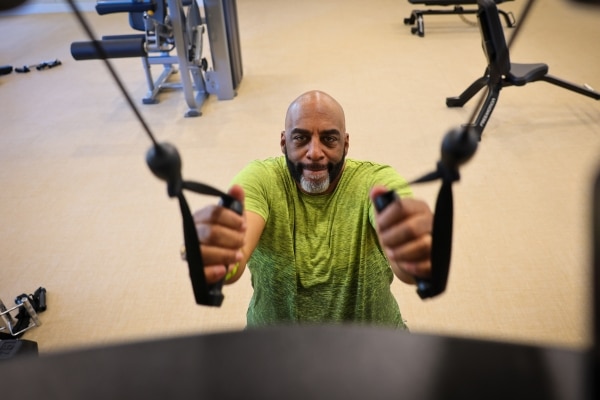
Robert is working out in the gym again after being unable to move without pain for so long.
ONE STEP AT A TIME
Robert began in a wheelchair, then progressed to a walker, then a cane — and eventually, to walking again. He reached a major milestone at a recent follow-up appointment.
“He was able to actually walk independently,” Dr. Graham says.
Today, Robert continues to rebuild his strength and return to the activities he loves. He’s back to exercising, riding a custom three-wheel bicycle, and working toward returning to production work.
Robert hopes others will listen to their bodies and seek care when something doesn’t feel right. And he knows just the place to tell them to go.