

Most of us might blame a stiff, achy shoulder on an awkward sleeping position or pulled muscle, but if weeks go by without relief, you could be suffering from a condition known as “frozen shoulder.”
“The early symptoms are easy to dismiss,” says Shaun Garff, DO, sports medicine specialist on the medical staff at Methodist Mansfield Medical Center. “If shoulder pain and stiffness last more than a few weeks, don’t ignore it.”
Known medically as adhesive capsulitis, frozen shoulder can also appear alongside another shoulder condition, including rotator cuff injuries, bursitis, and even arthritis — making an accurate diagnosis so important.
And while many shoulder aches improve with time, frozen shoulder could take years to heal.

WHAT IS IT?
Frozen shoulder is a condition where the capsule of the shoulder joint thickens, tightens, and develops scar tissue, restricting movement and causing pain.
“We don’t fully understand the exact cause, but it typically follows a period of reduced shoulder use due to an injury, surgery, or prolonged illness,” Dr. Garff says.
When left untreated, frozen shoulder can make everyday tasks agonizing, like getting dressed, reaching into a cabinet, or just fastening a seatbelt.
The condition affects women more often than men, and patients tend to be between the ages of 40 and 60. Anyone with uncontrolled diabetes and hormonal changes during menopause is at an increased risk.
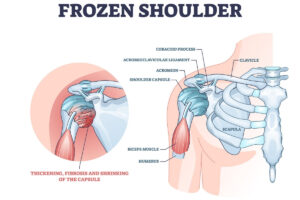
3 DISTINCT STAGES
There is no single test for frozen shoulder. Instead, your doctor will review symptoms, medical history, and perform a physical exam. An X-ray or MRI might be ordered to rule out other shoulder problems.
The condition slowly progresses through three distinct stages:
- Freezing: The first stage begins with a dull ache that often gets worse at night.
- Frozen: The shoulder becomes increasingly stiff, affecting its range of motion.
- Thawing: Mobility and movement gradually return after treatment.
“The earlier we diagnose it, the sooner we can begin treatment to reduce pain and restore motion,” Dr. Garff says.

HOW IT’S TREATED
Many people assume rest is the best treatment, but inactivity can cause more harm.
“Resting the shoulder completely often makes the problem worse,” Dr. Garff says. “The earlier we begin targeted treatment, the better the overall outcome.”
Physical therapy is one of the most effective treatments because it gradually restores flexibility without causing additional inflammation.
“Many patients also benefit from simple, gentle at-home exercises, including pendulum swings, towel stretches, and assisted cross-body stretches,” Dr. Garff says.
Early treatment often focuses on reducing inflammation with anti-inflammatory medications or corticosteroid injections. As pain improves, physical therapy becomes the foundation of recovery.
For patients who don’t improve with more conservative treatments, doctors may turn to arthroscopic surgery to release the tightened joint, manipulation under anesthesia, or shoulder hydrodilatation, which injects fluid into the joint to stretch the capsule.

JUST KEEP MOVING
There is no guaranteed way to prevent frozen shoulder, but staying active and mobile after an injury or surgery can dramatically reduce your risk.
“If you’ve recently had shoulder surgery or another medical condition requiring immobilization, always ask your doctor when it is safe to begin gentle movement,” Dr. Garff advises.
Proactively managing diabetes and keeping blood sugar under control may also help lower your risk profile.
“The sooner you find out what’s really causing your shoulder pain,” Dr. Garff says, “the sooner you can start getting your life, and your shoulder, moving again.”





Connect With Methodist