
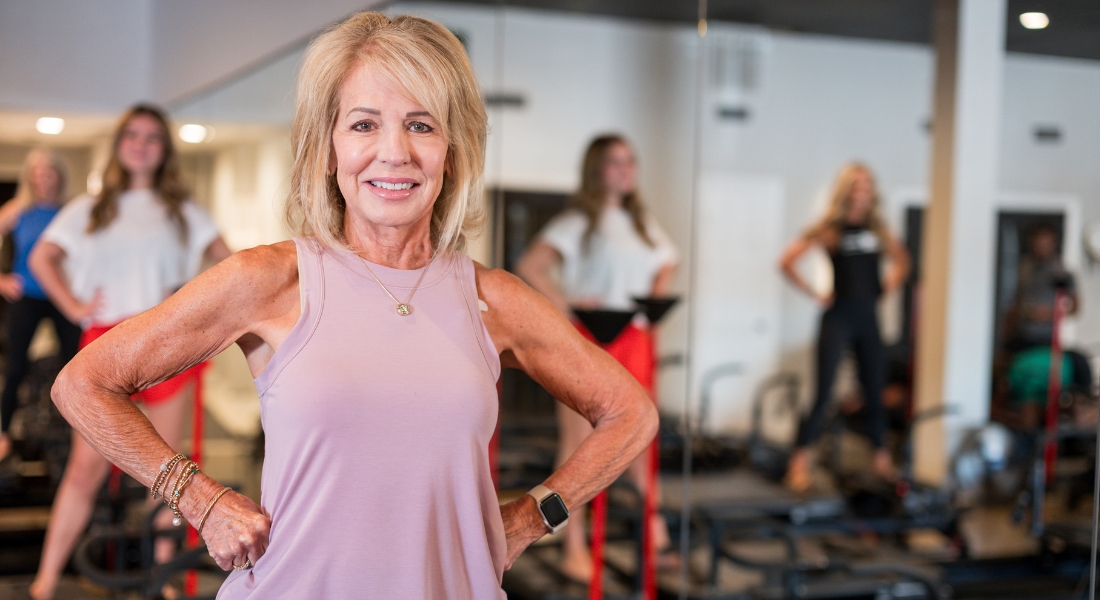
Nothing can stand between Debbi Rust and her regular Pilates class for long, not even a life-threatening hernia that cut off the blood supply to most of her digestive tract.
The 71-year-old from Waxahachie wound up in the ICU at Methodist Mansfield Medical Center after a trip to the emergency room ended in a 17-day stay.
“Every person who took care of me was just so loving and attentive,” Debbi says. “I can’t say enough good things about the nursing staff and the doctors.”
Those doctors and nurses marveled at this “tough lady” whose physical fitness played a major role in her recovery. Debbi, however, credits her faith and all the care and support she received.
“All the doctors said I was a miracle,” Debbi says. “It’s just been very eye-opening to me and very humbling to hear of all the people who were praying for me.”
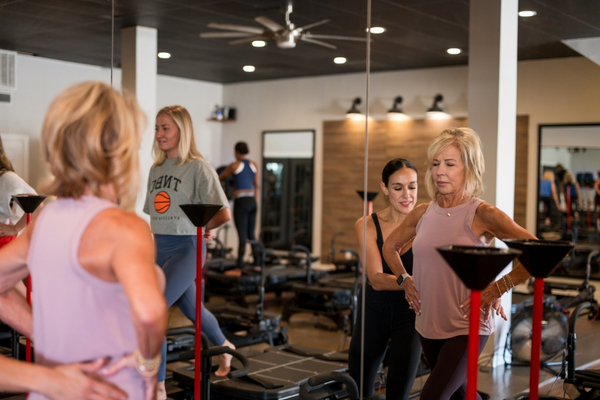
Debbi gets instruction from Celina Romney, owner of Lagree Theory Fitness in Midlothian.
‘VERY TOUGH LADY’
Hours before her trip to the ER, Debbi had been doing her routine Monday morning devotional when she was knocked off her feet by severe abdominal cramps.
“I went and lay down for a little bit, thinking that they would probably just pass,” she says. “And they just kept getting more intense.”
When her husband of 50 years, Joe, asked if he should drive her to the emergency room, Debbi realized her condition was more urgent.
“I said, ‘No. I think you need to call 911,’” she recalls.
After an ambulance ride to the ER, a CT scan showed a small obstruction in Debbi’s bowel, says Joshua Trussell, MD, general surgeon on the medical staff at Methodist Mansfield.
Debbi would need emergency surgery but hardly behaved like the critically ill patient she was when she scooted from a stretcher onto the operating table all by herself.
“I’ve got people with simple appendicitis who won’t do that,” he says. “I think she’s just a very tough lady. Not everybody expresses pain the same.”
Trust your gut to advanced GI care at Methodist by finding a digestive health specialist near you. Visit MethodistHealthSystem.org
EVERY CENTIMETER
During surgery, Dr. Trussell discovered a small band of scar tissue had created an internal hernia, and much of Debbi’s small intestine had twisted through the opening.
He released the band constricting Debbi’s intestine, allowing the blood to flow again, but the damage was done. It wasn’t immediately clear how much of her intestine could recover.
Removing all the damaged tissue could leave Debbi without enough small intestine to adequately absorb nutrients. Instead, the surgical team gave potentially viable areas time to recover while removing tissue that could not be saved.
“Every centimeter counts when you’re down to less than you need,” Dr. Trussell says.
Over the following days, Dr. Trussell returned to the operating room multiple times, preserving about 100 centimeters of small intestine and Debbi’s ileocecal valve, which helps the body absorb nutrients and fluids.
Debbi remembers little about those critical days. She was placed on a ventilator while her husband, three children, and dozens of loved ones waited and prayed.
“If someone was at the foot of my bed, I would just say, the best I could, ‘Please pray for me. Please pray for me,’” she says.

Debbi and her husband, Joe, recently celebrated 50 years of marriage.
BACK ON HER FEET
After her final surgery, Debbi began waking up and talking with her family. Soon, she was walking the halls of Methodist Mansfield’s Neuro Critical Care Unit, where some staff members were stunned to see her on her feet so soon.
“I’d turn around, and it would be a nurse I didn’t recognize,” Debbi says. “She said, ‘I was here when they brought you in. I can’t believe here you are walking.’”
After 17 days in the hospital, Debbi was strong enough to go home without needing inpatient rehabilitation.
Both she and Dr. Trussell credit her health before the emergency with helping her recover. Debbi had no significant medical history and regularly practiced high-intensity Pilates.
“An unhealthy person with a lot of medical issues may not have survived this,” Dr. Trussell says. “A lot of this is credit to her being in such good shape.”
Debbi praises the doctors and nurses who cared for her, remembering not only the lifesaving treatment but the small gestures that helped her through it. As for her own physical fitness, she puts the credit elsewhere.
“I’ve had people tell me that just how I’ve taken care of myself over the last 30-something years, probably God was preparing me for this,” she says.

Debbi’s daughter Lauren Ewings (left) and granddaughter Ava Rust work out beside her.
LISTEN TO YOUR BODY
With only about 100 centimeters of small intestine remaining, Debbi relies partially on IV nutrition to supplement what her body can absorb through food.
“She’s done better than expected with the amount of bowel she has,” Dr. Trussell says.
During the day, Debbi eats and hydrates on her own, keeps a food journal and slowly experiments with what her body can tolerate. She’s even made it back to Pilates, returning months earlier than she originally expected.
“As women, I think a lot of us are strong. We’re tough,” she says. “But there was something different about that day, about that pain, and I finally listened to my body.”
Debbi hopes her story encourages others, particularly women accustomed to pushing through aches and pains, to listen when their body tells them something isn’t right. Surviving her worst days has also changed the way she treasures the ordinary days that followed.
“Sometimes I feel like the greatest miracle isn’t simply that I survived this whole thing,” Debbi says. “It’s that I’ve learned to cherish the life that I’ve been given.”





Connect With Methodist