

On a Dallas highway in the middle of a shift, truck driver Jack Pach was blindsided by chest pains and a near-total blockage in a major artery.
The 64-year-old from Hood County pulled over on an exit ramp, sweating profusely and barely strong enough to hold his phone to call his wife, Crystal, and then 911.
Jack was sure he wouldn’t live to see his 65th birthday the very next week.
But paramedics rushed him to Methodist Southwest Medical Center in seven minutes flat, where the staff quickly restored his blood flow to prevent a major heart attack.
“They didn’t lollygag around,” Jack says. “They treated me like I had to be treated now.”
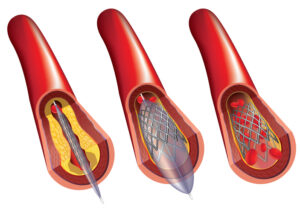
Angioplasty uses a catheter to reopen a blood vessel, then keeps it open by leaving behind a stent.
TRIP TO THE CATH LAB
While Jack didn’t suffer a heart attack, the emergency team at Methodist Southwest quickly discovered a 99% blockage in his right coronary artery and decided to monitor him overnight.
The tests convinced Deepak Asti, MD, interventional cardiologist on the medical staff, that Jack would need a stent to open the blockage, and he was quickly moved to the cardiac cath lab for an angiogram.
“I felt this should be handled right away, and that’s the reason he got the angiogram done immediately,” Dr. Asti says. “Our cath lab team worked very swiftly.”
An angiogram is a minimally invasive procedure used to identify blockages in the arteries around the heart. A catheter was inserted into a blood vessel in the wrist or groin and threaded all the way into the heart.
From there, dye is injected through the catheter into the bloodstream to locate the blockage with an X-ray, before a permanent stent is placed in the heart to improve blood flow.
“I don’t even think the whole process took a half hour, it was awesome,” Jack says. “When it was all done and the medicine wore off, I just felt energized and I’ve been that way pretty much ever since.”
From prevention to advanced procedures, trust your heart to the innovative, personalized care that Methodist provides. Visit MethodistHealthSystem.org
FELT LIKE ‘ONLY PATIENT’
This wasn’t the first heart scare for Jack, who experienced two similar episodes that ended in the cath lab.
This was the first time his stent was placed through his wrist, however, and the recovery process was much improved — as was his care at Methodist Southwest, Jack says.
“It was like I was the only patient they had to deal with,” he says. “When I got in my room, they made me super comfortable.”
Jack credited the nursing staff and Dr. Asti’s team for keeping him informed throughout his testing and treatment.
“They were really informative if I had any questions. From the stent, back to the room, to when I left, it was all seamless,” he says. “That’s how it should be when you go to a hospital.”

Jack and his wife, Crystal, celebrated his 65th birthday a week after he left Methodist Southwest.
CELEBRATING HIS 65th
After his procedure, Jack was discharged after another night in the hospital. He was even surprised by a visit from his daughter, Shayla, who worked for the system as a respiratory therapist at the time.
He hopes he won’t need to visit a hospital again anytime soon, but he knows where he’d ask first responders to take him.
“If I had my options, it would always be Methodist,” he says.
A week after his discharge, Jack was still recovering but comfortably celebrated his 65th birthday with his family.
“I appreciate all the people that helped me,” Jack says. “I want to thank everybody that had anything to do with me, thank them for saving my life.”





Connect With Methodist