

Stephanie Frankiewicz mistook severe appendicitis for a bad case of indigestion, until a “just in the nick of time” trip to the ER of her hometown hospital.
“Yup, it’s your appendix,” the Realtor recalls the staff telling her at Methodist Midlothian Medical Center, “and we’re taking you upstairs for surgery tomorrow.”
Stephanie had the inflamed organ removed using robotic-assisted surgery in February 2026. A lifelong resident of Midlothian, she raved about her experience in the expanding emergency department.
“I don’t have enough nice things to say about the Methodist Midlothian ER,” she says. “It’s such a blessing to have this close by, so I don’t have to go to another town to seek care.”
Trust your gut to advanced GI care at Methodist by finding a digestive health specialist near you. Visit MethodistHealthSystem.org
EMERGENCIES CAN’T WAIT
Stephanie initially thought the pain directly behind her navel was caused by constipation or gas. But soreness in that spot can also be the first symptom of appendicitis.
Neglecting the signs of appendicitis is risky. Inflammation of the worm-shaped organ at the end of the large intestine can cause it to rupture in two to three days, radiating infectious bacteria throughout the abdominal cavity and leading to life-threatening complications.
As the inflammation worsens, the pain sharpens and shifts to McBurney’s point, the anatomical landmark on the lower right side of the abdomen where appendicitis causes maximum tenderness.
“We decided to err on the side of caution, and my daughter insisted on driving me to the ER,” Stephanie recalls. “It was a very busy night, but they got to me very quickly.”
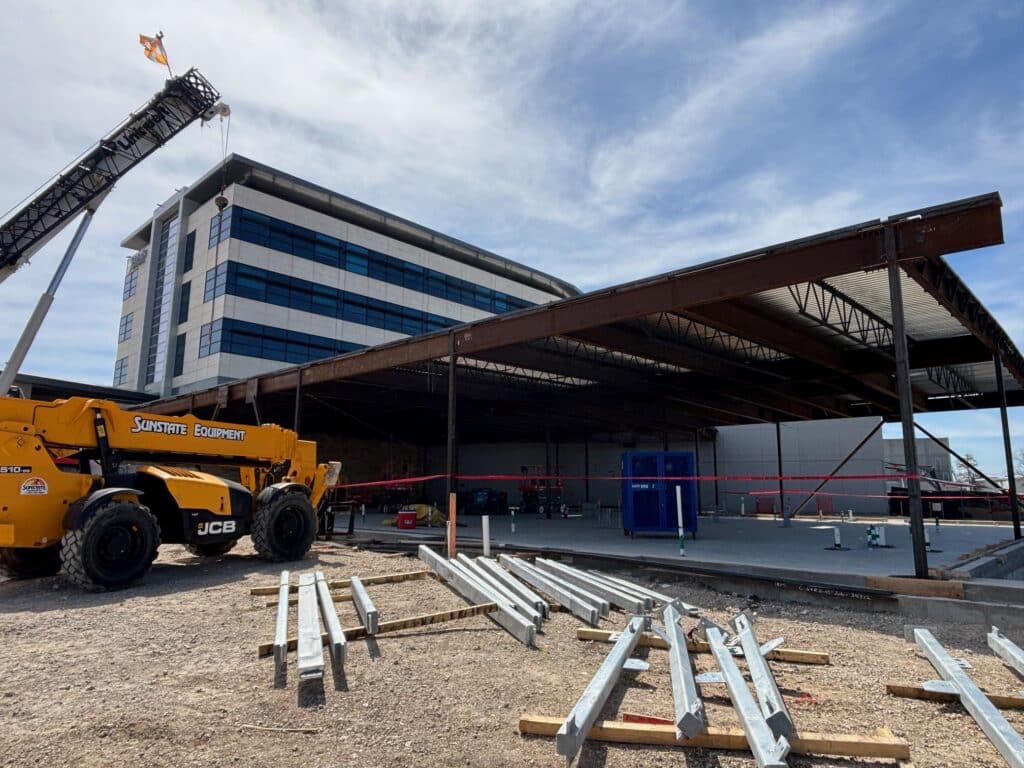
A $24.8 million expansion will double the capacity of the Methodist Midlothian ER.
BUSY ER THAT’S GROWING
Six years after opening in 2020, the emergency department at Methodist Midlothian is so busy that it’s expanding through a $24.8 million project that will double the number of exam rooms to 32.
“I’ve worked here since day one, and it’s busier every year, so we definitely can use the extra space,” says Kelsey English, MD, emergency medicine physician on the medical staff at Methodist Midlothian. “We tend to draw from Waxahachie and Venus and the whole Ellis County area.”
The staff in the ER took Stephanie’s vital signs, plus urine and blood samples, and Dr. English gave her a morphine injection to ease the pain, then started her on antibiotics after a CT scan confirmed a diagnosis of appendicitis.
“She had pretty rapidly progressing abdominal pain and a tender lower abdomen,” Dr. English says. “Her case shows that if you experience something atypical and it continues to progress, you should get seen by the emergency department.”
 Stephanie has “learned to listen to her body” and intends to return to the hospital to repair a hiatal hernia.
UNEXPECTED DISCOVERY
Stephanie’s appendix was removed the following afternoon by Jeremy Parcells, MD, general surgeon on the medical staff at Methodist Midlothian. He had a robotic assist from the da Vinci Surgical System, which gives a surgeon greater precision and allows for quicker recoveries.
During the minimally invasive surgery, Dr. Parcells discovered that Stephanie also suffers from a hiatal hernia, an often undiagnosed condition where part of the stomach pushes through the diaphragm and can cause gastroesophageal reflux disease.
“I’ve been suffering from GERD forever,” says Stephanie, who plans to have Dr. Parcells repair the hernia next so she can discontinue her daily medication. “I take the highest dose of proton pump inhibitor for it every day.”
Not long after her surgery, Stephanie was able to go out to lunch with her colleagues. She feels fortunate to have caught her condition before it got worse and won’t think twice about visiting her hometown hospital again, whenever necessary.
“I learned to listen to my body,” she reflects. “Had I put it off another 24 hours, it could have ruptured and caused three months’ worth of issues instead of an overnight stay in the hospital.”