
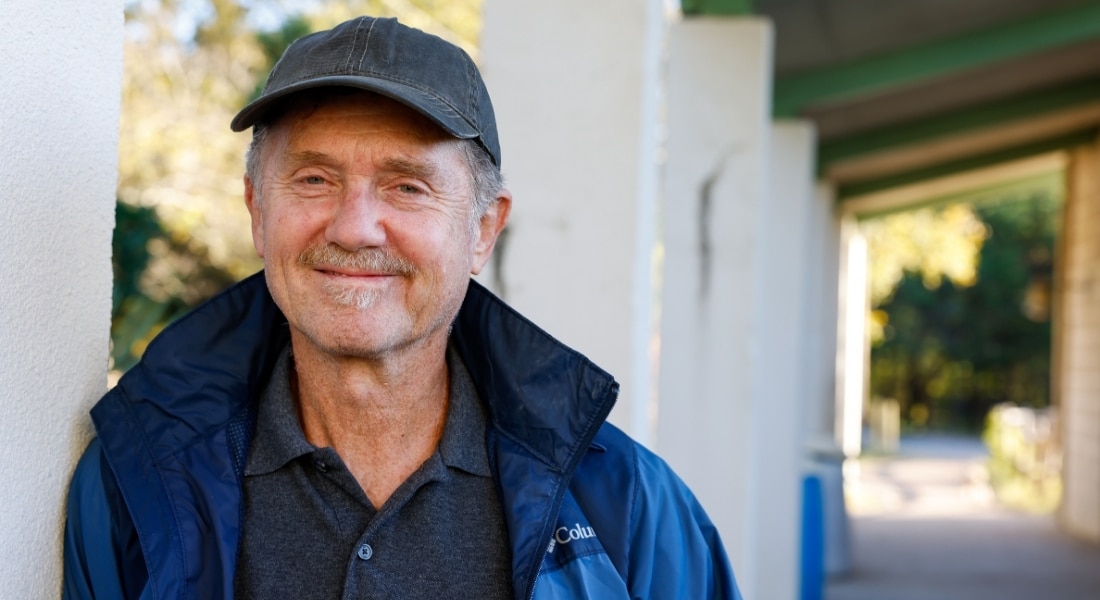
Diabetes typically comes in one of two types, but that wasn’t the case for Dan Bryant, who needed help managing a hybrid variety often referred to as “type 1.5 diabetes.”
“It started out with the symptoms of type 2 diabetes, and then the pills just stopped working,” says Dan, who’s 65 and lives in Cedar Hill. “I got the doctors to retest me, and it turns out I’m insulin-dependent.”
Dan is not alone. Latent autoimmune diabetes in adults, or LADA, is fairly common. Up to 12% of people initially diagnosed with type 2 diabetes actually have LADA.
“This diagnosis and the care I received from the pharmacy at Methodist Dallas Medical Center were life-changing,” says Dan, who’s retired but still works as a freelance photographer. “Those doctors helped me get my life back on track.”

DIABETES DRUGS STOP WORKING
More than 38 million American adults have been diagnosed with type 2 diabetes, so that means more than 4 million may actually have LADA, otherwise known as type 1.5 diabetes.
“It fits my profile exactly,” Dan says, reflecting on a disease he was diagnosed with only a few years ago. “I exercise all the time, and I’m skinny. And still I was losing weight and became diabetic.”
For about two years, Dan managed his diabetes with medication, namely metformin, glipizide, and pioglitazone – the first line of defense for adults dealing with type 2 diabetes.
“Those were really working – until they weren’t,” he says. “I would check my blood sugar, and it would be 275 or 300, and I couldn’t get it to come down.”

SYMPTOMS OF HYPERGLYCEMIA
That caused Dan to suffer from constant fatigue, blurred vision, tingling in his hands and feet, and weight loss – all textbook symptoms of hyperglycemia, or high blood sugar.
Dan first considered another prescription drug that can cost up to $600 a month.
“I’m retired, and it was going to cost me quite a bit of money out of pocket,” he says. “And what if it doesn’t work?”
That’s when Dan’s primary care physician, Wisam Nachawati, DO, family medicine specialist on the medical staff at Methodist Mansfield Medical Center, stepped in with an assist from Medication Therapy Management.
Learn more about how a referral to Medication Therapy Management can help you manage your medicines Visit MethodistHealthSystem.org
PANCREAS UNDER FRIENDLY FIRE
Dr. Nachawati suspected that Dan was no run-of-the-mill type 2 case but rather his body was creating antibodies that were attacking the insulin-producing beta cells in his pancreas – just like a type 1 case of diabetes.
“That basically destroys the pancreas,” he says. “Certain medications can tell the pancreas to make more insulin, almost like hitting a horse with a whip. But pretty soon, the horse is going to be too tired.”
Dan was tired, all the time, and his blood sugar was through the roof, no matter what he ate.
“My blood sugar was 300, and I was eating broccoli and salad,” he says. “I thought, I can’t live like this. I have to eat or I’m going to die.”
The solution for Dan was to go on supplemental insulin and to monitor his blood sugar 24/7 with a glucose monitoring device, both supplied through MTM, a program that pairs patients like him with a clinical pharmacist who helped educate Dan and rein in his blood sugar. The results were immediate.
“Flash forward one week later, and his hyperglycemia was resolved and symptoms were much better,” says Thanh Lam, PharmD, manager of pharmacy services at Methodist Dallas. “His vision improved, and the tingling in his fingers and toes subsided.”

KEEPING A CLOSE EYE
Along with Dr. Nachawati, Dr. Lam would become an integral member of Dan’s healthcare team, answering any questions about doses and prices that might come up.
“Dr. Lam monitored me through my Dexcom over the first six months,” says Dan, whose glucose monitor transmits to a smartphone app and to both doctors. “He was really, really great. I love both of those guys.”
Today, Dan has his type 1.5 diabetes under control and has gotten back to doing what he loves, often in the great outdoors and on two wheels.
“I’m going all the time riding mountain bikes and motorcycles,” he says. “Before this, I thought, man, if I can’t live a quality of life, I don’t even want to be around.”
Best of all, Dan says, he’s able to enjoy eating again.
“I don’t smoke, I don’t drink, but my vice is I like to eat,” he says. “Now I can actually have a piece of pie every once in a while.”





Connect With Methodist