

It may not be rocket science, but the robotic technology that helped Nick Petrichenko overcome prostate cancer has been every bit as life-changing for him.
The retired engineer at Lockheed Martin has friends who struggled with the same disease, so he was thrilled to learn about a new minimally invasive option available at Methodist Southwest Medical Center.
“This is kind of cool technology,” says the 69-year-old from Ovilla, who took up welding as a pastime. “If this is what it takes to beat cancer, this was the best way to go by far. It’s so noninvasive.”
Nick was treated with a robotic system using high-intensity focused ultrasound, or HIFU, in March 2026. He was an ideal candidate for the hour-long outpatient procedure because his cancer was caught early.
“My wife and I are big champions of early detection,” Nick says of Mary, his wife of 44 years, who chimes in, “Don’t be afraid to get checked. Don’t wait.”
NO WARNING SIGNS
About 1 in 8 men will be diagnosed with prostate cancer, and the incidence rate for the disease has grown by 3% each year since 2014, according to the Centers for Disease Control and Prevention.
This year, about 333,000 new cases of prostate cancer are expected to be diagnosed, compared with 255,000 in 2022, according to the American Cancer Society. That’s partly because age is the biggest risk factor, and baby boomers are at the stage when their risk is highest.
“If you live long enough, it can happen to anybody, but I had no symptoms at all,” says Nick, who got his first hint that something was wrong when a blood draw returned an abnormally high level of prostate-specific antigen, or PSA.
At Methodist, we don’t just focus on your cancer. We care for you as a whole person. Learn more at MethodistHealthSystem.org
In its earliest stages, prostate cancer rarely causes symptoms, so physicians depend on PSA screening to detect it. But high PSA levels can also signal benign conditions, such as an enlarged prostate or infection.
But when Nick returned weeks later, his PSA had risen even higher, so he was referred to Srinath Kotamarti, MD, urologist on the medical staff at Methodist Southwest.
“I cannot say enough kind words about Dr. Kotamarti and his team,” Nick says. “They were professional and caring, and we never felt rushed.”
Time was of the essence, however, when a biopsy detected several nodules on Nick’s prostate. The cancer had not spread beyond the gland, making him a prime candidate for HIFU.
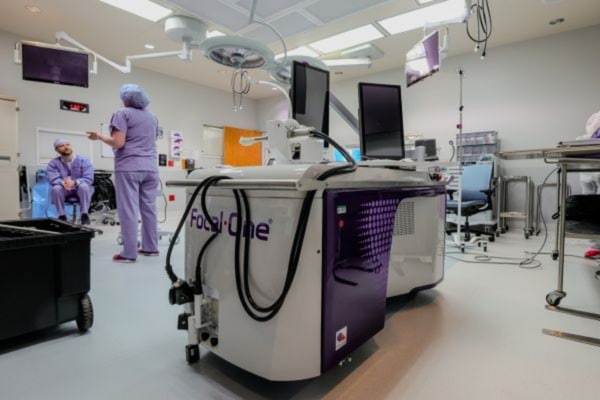
HIFU uses ultrasound energy to kill cancer cells, giving doctors extra precision in a hard-to-reach area.
HIFU STRIKES BALANCE
The prostate is in a location that makes it extremely challenging to get to without affecting the surrounding organs. When prostate cancer is advanced, it may require radiation or even removal, a surgery known as a prostatectomy.
“We had a friend that had radiation. We had a friend that had his prostate removed,” Nick says. “Neither one of them are exactly happy with where they are at now.”
Those difficult experiences made the prospect of a new alternative so intriguing to Nick and Mary when Dr. Kotamarti told them about the HIFU robot at Methodist Southwest.
“The issue with radiation and surgery to remove the prostate is that you can compromise patients functionally while having a great cancer outcome,” Dr. Kotamarti says. “HIFU provides the optimal balance between a quality outcome and good quality of life.”
Not everyone is an ideal candidate for HIFU, which works best when the cancer is confined to the prostate.
“It all comes back down to screening, finding things early,” Dr. Kotamarti says. “If it’s caught early, you can nip it in the bud.”

Nick and his wife, Mary, are eager to return to their globetrotting ways.
‘BACK TO NORMAL’
That’s just what Dr. Kotamarti and his team did for Nick, who was admitted to Methodist Southwest at 7 a.m. for the outpatient procedure and was back home by 1 p.m.
Using the Focal One HIFU Robotic System, Dr. Kotamarti destroyed the cancer with ultrasound energy — and without a single incision. The tool gives physicians the precision they need to limit side effects associated with more invasive options, like erectile dysfunction and incontinence.
“Once the catheter was out, I was back to normal,” Nick says. “We even drove to Ohio and Arkansas within weeks after the procedure.”
Nick remains in remission and will follow up with Dr. Kotamarti for two years to ensure he stays that way. In the meantime, he’s urging every man he knows to get screened and not put off a visit to the urologist.
“Get your PSA checked and react to it,” he says. “Don’t just put it off, because it’s not worth it. This procedure is way better than any of the other options.”





Connect With Methodist