
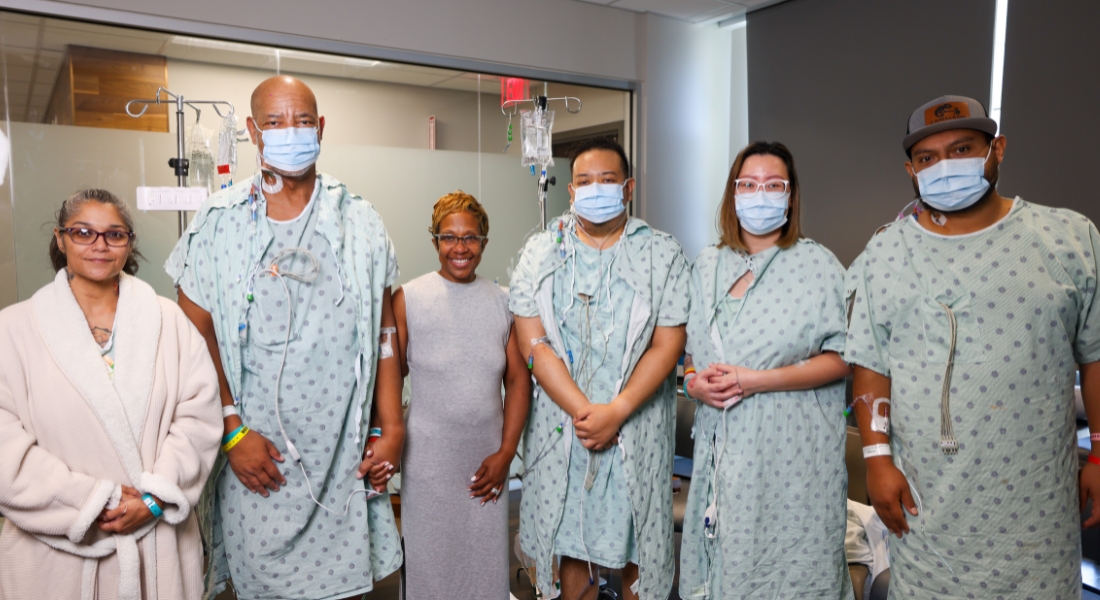
For six people at Methodist Dallas Medical Center, a series of lifesaving acts fell into place like a row of dominoes.
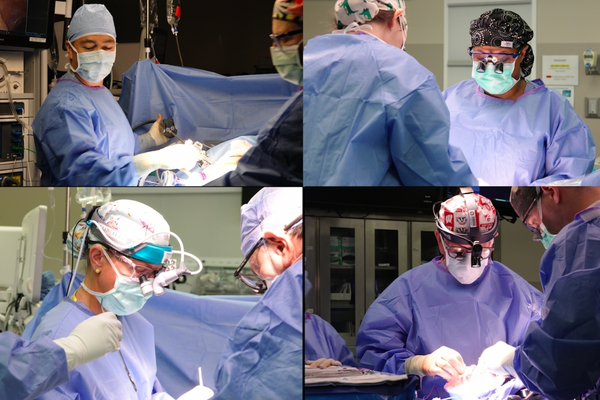
Four transplant surgeons on the medical staff performed the hospital’s first “domino transplant,” transplanting three kidneys back-to-back-to-back over 13 hours in a single day of meticulously coordinated surgery.
“Kidney pair donations, especially internal chains, require a lot of work by our living donor coordinators, the managers, the operating staff, and of course our surgeons,” said Amna Ilahe, MD, transplant nephrologist on the medical staff at Methodist Dallas. “Everything has to come together at the right time.”
All three patients in need of a kidney had to rely on the generosity of strangers because they could not find a perfect match among their loved ones. Instead, the wives of two recipients paid those lifesaving gifts forward by donating their own organs.
“It’s probably the most selfless act that someone can do,” said Reggie Jackson, a Denton County lawyer whose new kidney was the first domino to fall. “I’m hopeful that this story helps people have the confidence and the courage to be donors and save a life.”
CHAIN REACTION OF GIVING
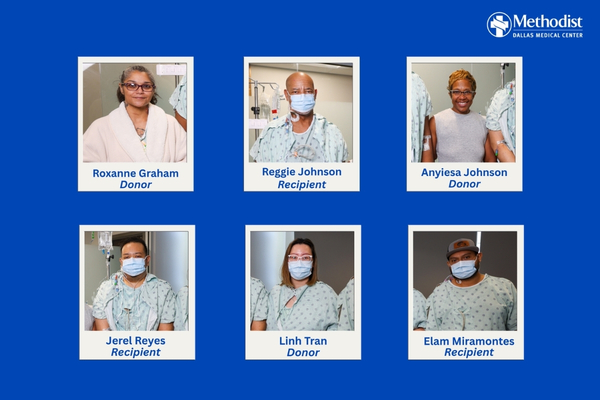
The chain started with Roxanne Graham, a 48-year-old Burleson woman who donated her kidney to relieve the pain of Nutcracker syndrome, a rare vascular condition named because the vein that carries blood from the heart to the kidneys gets compressed between two arteries.
“This is the best way to fix me, and it gets to help someone else,” Roxanne says. “It’s a win-win situation.”
In this case, her selfless act triggered a win-win-win situation because Roxanne donated her kidney to Reggie, whose wife donated to an Irving man, and his wife, in turn, donated to a Dallas man.
This is Reggie’s second transplant after his sister donated her kidney to him 23 years ago.
“We are blessed to be part of this chain,” Anyiesa said. “We just celebrated 31 years of marriage, and we are looking forward to 31 more.”
With decades of experience and a patient-centered focus, Methodist Dallas has built a national reputation for transplant excellence. Visit MethodistHealthSystem.org
Reggie’s wife, Anyiesa, donated to Jerel Reyes, a 38-year-old who was diagnosed with a kidney disease more than a decade ago.
“He was on dialysis for about a year,” says Jerel’s wife, Linh Tran, who donated her kidney in exchange for the organ her husband received. “We got the call about a month ago, and he’s like, ‘I’m not ready,’ and I said, ‘You better get ready!”
Jerel’s wife, Linh Tran, wanted to donate her kidney to her husband, but like Reggie and Anyiesa, testing revealed the couple were biologically incompatible. Linh’s kidney instead went to Elam Miramontes of Oak Cliff.
“I feel excited, happy to see everybody being blessed,” says Elam, a 36-year-old who spent three years on dialysis while waiting on a transplant list.
FULL DAY OF SURGERIES
The surgeries were performed over 13 hours on a single day by four transplant surgeons on the medical staff at Methodist Dallas: Alejandro Mejia, MD, executive director of organ transplantation at Methodist Dallas; Richard Dickerman, MD, surgical director of the kidney and pancreas transplant program; Christie Gooden, MD; and Lori Kautzman, MD.
Before the surgeries, each patient underwent extensive testing to ensure they were healthy enough to donate or receive a kidney and to determine whether their kidney was a biological match. Not only must their blood types match, but their tissue types and immune systems must align to ensure the recipients’ antibodies don’t attack the new kidney.
The process takes hours of collaboration across medical teams and painstaking lab work behind the scenes.
“The living donor coordinators, the managers, the operating staff, and of course, our surgeons really have to work hard,” Dr. Ilahe says. “We have to make sure all those six people are healthy, ready to do the surgery, and the surgeries need to happen the same day.”
Dr. Ilahe says there are several advantages to using living donors if they are available, including the kidneys performing more efficiently and speeding up years-long wait times for patients in dire need.
“Living donation is a very important aspect of transplantation,” says Dr. Ilahe. “There are about 100,000 patients on the deceased donor lists. The wait time is around four to five years across all blood groups. Living donation helps decrease the severe gap, so more recipients can be transplanted.”
MEET AND GREET
All six patients met for the first time just two days after their successful transplants to thank one another for the gift of a lifetime.
“I am grateful that I was healthy enough to donate,” says Anyiesa. “That Roxanne had the heart to donate, that Linh had the heart and health to donate, and so that these gentlemen could live their lives.”
Each of the patients were given a set of dominoes by Methodist Dallas staff to honor the milestone.
“This was just meant to be,” says Roxanne.
BACK TO LIFE
The patients hope their story shows others how living donation can change the trajectory of someone’s life, whether it’s a loved one or a perfect stranger who happens to be a perfect match.
“It’s got to be a personal decision,” says Anyiesa, who wants others to know that living a normal life with one kidney is possible. “The more we can talk about it, the more people might not be as frightened about it.”
Linh says one of her biggest challenges was convincing her family that giving up her kidney for her husband’s sake did not put her at risk.
“I had to reassure them,” she says. “I am going to be fine as long as I take care of myself, we are going to be fine.”
All six patients — three donors and three recipients — are looking forward to doing what they love, like traveling the world and supporting their children, and the things they used to take for granted, like going to work.
“I can’t wait for them to be able to live life and have fun,” says Roxanne. “We’re all waiting to get back to life.”




Connect With Methodist