

The symptoms of Parkinson’s disease are often subtle and can be mistaken for getting older, which happens to be the greatest risk factor for the disease.
“Parkinson’s disease most often begins between ages 60 and 70,” says Frederic Nguyen, MD, neurologist on the medical staff at Methodist Richardson Medical Center. “When symptoms start before age 50, it’s called ‘young-onset’ Parkinson’s.”
Developing Parkinson’s disease before middle age is uncommon but not rare, affecting between 4% and 10% of the estimated 1 million Americans who live with this progressive neurological disorder that affects movement, balance, and coordination.
While any adult could be diagnosed with Parkinson’s disease, the risk factors involve a blend of genetic, environmental, and ultimately unknown variables. Knowing the symptoms is the first step, and seeking care before the disease progresses is critical.
“Parkinson’s care is a team effort that often starts with a visit to your primary care physician,” Dr. Nguyen says. “They can help evaluate symptoms and refer you to a neurologist if needed.”

FIRST WARNING SIGN
A resting tremor is one of the most recognizable early signs of Parkinson’s disease, often affecting the hands, fingers, or chin.
But tremors can also result from physical exertion, exhaustion, stress, or even overindulging in caffeine, making it difficult to know when concern is warranted.
“A Parkinson’s tremor often starts on one side and may look like a ‘pill-rolling’ motion,” Dr. Nguyen says. “When paired with slowness and stiffness, a resting tremor becomes more suggestive of Parkinson’s.”
In contrast, a more common “essential tremor” typically affects both hands and appears during movement, such as holding a cup or writing.
Similarly, older adults frequently experience joint stiffness from arthritis and muscle soreness. But when stiffness occurs alongside balance problems, reduced arm swing, or tremors, it may point toward Parkinson’s disease rather than routine aging.

NOT JUST TREMORS
Not all early symptoms of Parkinson’s disease involve movement. In fact, some of the earliest signs may affect sleep, digestion, or the senses.
One common symptom is hyposmia, or a reduced sense of smell, which affects up to 90% of people with Parkinson’s disease. Patients may have trouble detecting certain odors long before movement symptoms appear.
“Sleep changes can also be an early warning sign,” Dr. Nguyen says. “One example is acting out dreams, a condition called REM sleep behavior disorder (RBD) that manifests in kicking, talking, or moving during sleep.”
He cautions that symptoms like hyposmia and RBD alone aren’t enough to indicate Parkinson’s disease. Loss of smell, for example, can occur with aging, allergies, sinus problems, or previous viral infections.
These symptoms do become more clinically significant, however, when they appear together with constipation, tremors, or subtle movement changes.
LOSS OF DOPAMINE
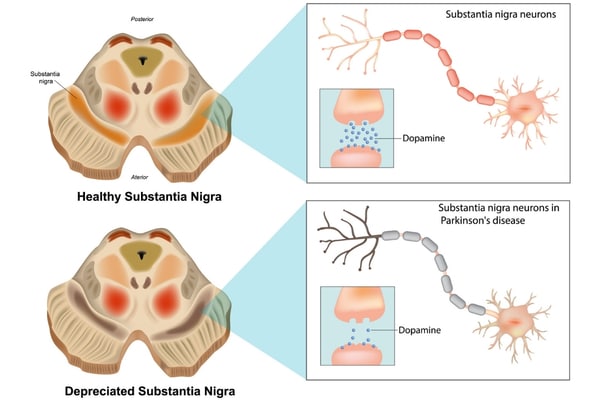
Parkinson’s disease attacks a part of the brain known as the substantia nigra, a motor control and reward center that produces the dopamine needed to relay messages to the nerves.
As we age, cells in that part of the brain naturally die off, but that process is accelerated in people with Parkinson’s disease. Symptoms begin to emerge when 50% to 60% of those dopamine-producing neurons are gone.
When the neural pathways responsible for controlling movement are disrupted, several subtle changes may develop over time:
- Micrographia — handwriting that becomes unusually small or cramped
- Hoarseness — softer, breathier, or hoarser speech
- Masked face — facial expressions become less pronounced, a condition known as hypomimia
“These changes are part of the same process that causes slowness and stiffness,” Dr. Nguyen says.

HOW IT’S TREATED
Although there is currently no cure for Parkinson’s disease, many treatments can improve quality of life and help patients manage symptoms effectively.
Parkinson’s care often involves a team-based approach that may include:
- Medications to improve movement symptoms
- Physical therapy for mobility, flexibility, and balance
- Occupational therapy to assist with daily tasks
- Speech therapy for voice projection and swallowing difficulties
Early recognition and evaluation can make a meaningful difference, allowing patients to access therapies and support sooner and better manage the progression of the disease.
“The best treatment focuses on managing symptoms and helping people stay active, independent, and engaged in daily life,” Dr. Nguyen says.