
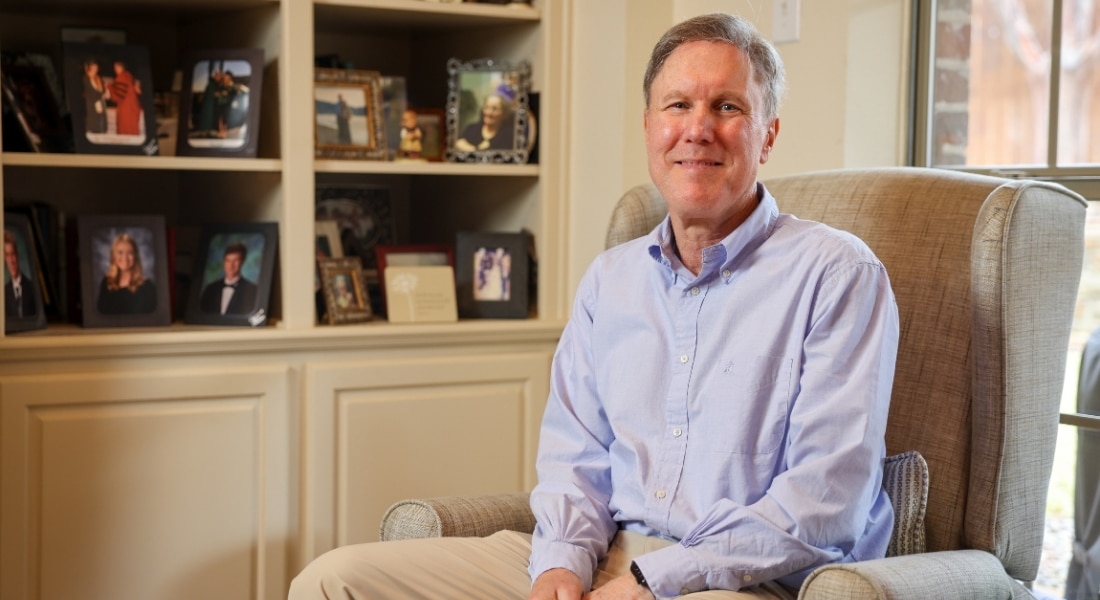
When Southlake paramedics rushed Jim Hunt to the hospital after his heart attack last fall, the room around him came alive — fast.
Voices called out instructions as soon as the doors opened at Methodist Southlake Medical Center. In moments, he was rolled into the cardiac catheterization lab, and multiple people rushed in at once, each stepping into a specific role.
“They come out here like a pit crew,” says Jim, describing the team of technicians who surround a racecar to get the driver back on track as quickly as possible. “It was amazing the number of people who were already there waiting for me.”
To the 64-year-old from Keller, it felt less like chaos and more like precision, with each person doing exactly what he or she was trained to do. In no time, a stent had been placed to restore normal blood flow to Jim’s heart.
“The entire time, they were really reassuring, telling me what they were doing, what was going on, and keeping me up to date. They took great care of not only me but my family.”
PARAMEDICS TO THE RESCUE
Jim exercises regularly, stays active, and has no family history of heart disease, so he had no reason to believe anything serious was wrong when he began feeling mild discomfort in his chest one Friday in September.
“I thought it was indigestion or maybe heartburn,” says Jim, who was alone and working from home that morning. “I really didn’t think a whole lot of it.”
Neither did his wife, Diana, who was at a yoga class in Dallas at the time.
“I left a very healthy husband early that morning,” she says. “The next time I saw him, he’s in a hospital bed. It was surreal.”
From prevention to advanced procedures, trust your heart to the innovative, personalized care that Methodist provides. Visit MethodistHealthSystem.org
But within hours, Jim’s pain had intensified, and he drove himself to an urgent care clinic. Staff at the clinic called 911, and firefighters from the Southlake Fire Department arrived within minutes and confirmed Jim was having a heart attack.
“They got nitro under my tongue, got me in an ambulance, and got me to Methodist Southlake, probably within 10 minutes,” Jim says.
Because emergency responders alerted the hospital while Jim was still en route, the cardiac team at Methodist Southlake was prepared for his arrival.
That commitment to patient care has earned Methodist Southlake its national accreditation as a Primary Heart Attack Center, proof positive of a cardiology team that works quickly and efficiently.
“I remember them rolling me into the cath lab,” Jim says. “There were at least seven or eight people standing there.”
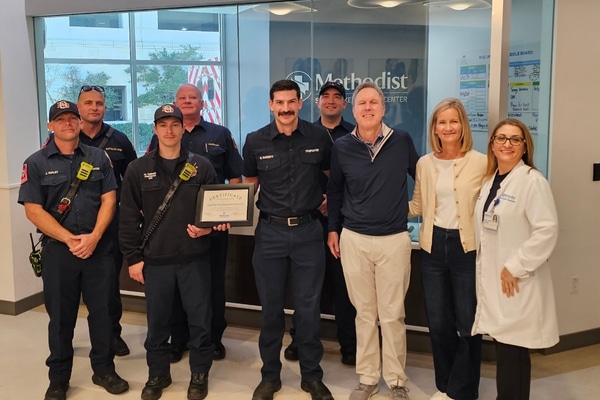
Jim returned to Methodist Southlake to thank the paramedics who saved him, along with Dr. Kruger (right).
ANGIOPLASTY OPENS ARTERY
Leading that “pit crew” was Mihaela Kruger, MD, an interventional cardiologist at Methodist Southlake, who determined that Jim had a severe blockage in one of his heart’s major arteries.
“We accessed the blood vessel from the radial artery,” she says, explaining the process of using a catheter inserted through the wrist. “We put the wire up with the tube to the base of the heart, inject dye, and take pictures to see what’s going on.”
Once the blockage was identified, a tiny balloon on the tip of the catheter opened the artery, and a stent was placed to keep it open.
“The balloons we use, we inflate at very high pressure,” Dr. Kruger says, describing how angioplasty works. “We open up the blood vessel to restore blood flow.”
Speed was critical.
“Every minute counts,” Dr. Kruger says. “The most important part of all this is the quick recognition of an acute heart attack and immediate communication between EMS, the ER, and the cath lab team.”
Because EMS activated the cardiac team immediately, Jim’s care moved quickly — helping minimize damage to his heart.

Jim’s wife, Diana, won’t take her husband’s health for granted again after this “surreal” experience.
DON’T SHRUG OFF SYMPTOMS
Jim stayed overnight at Methodist Southlake and was released the next day. It didn’t take long for the staff to make an impression.
“The nurses and the entire staff were fabulous,” he says. “They communicated well and were very attentive.”
After a couple of weeks of cardiac rehabilitation, Jim had eased back into exercise and everyday life. Looking back, he hopes his story encourages others not to dismiss symptoms — even subtle ones.
“If you feel anything that does not feel normal in your chest area, get it checked out immediately,” he says.
His wife, Diana, is just happy to have more time with Jim, and that gratitude often shows up in the quiet moments.
“One night he was fast asleep, and he started to snore,” she says. “I just listened to him, and I was so very thankful.”



Connect With Methodist